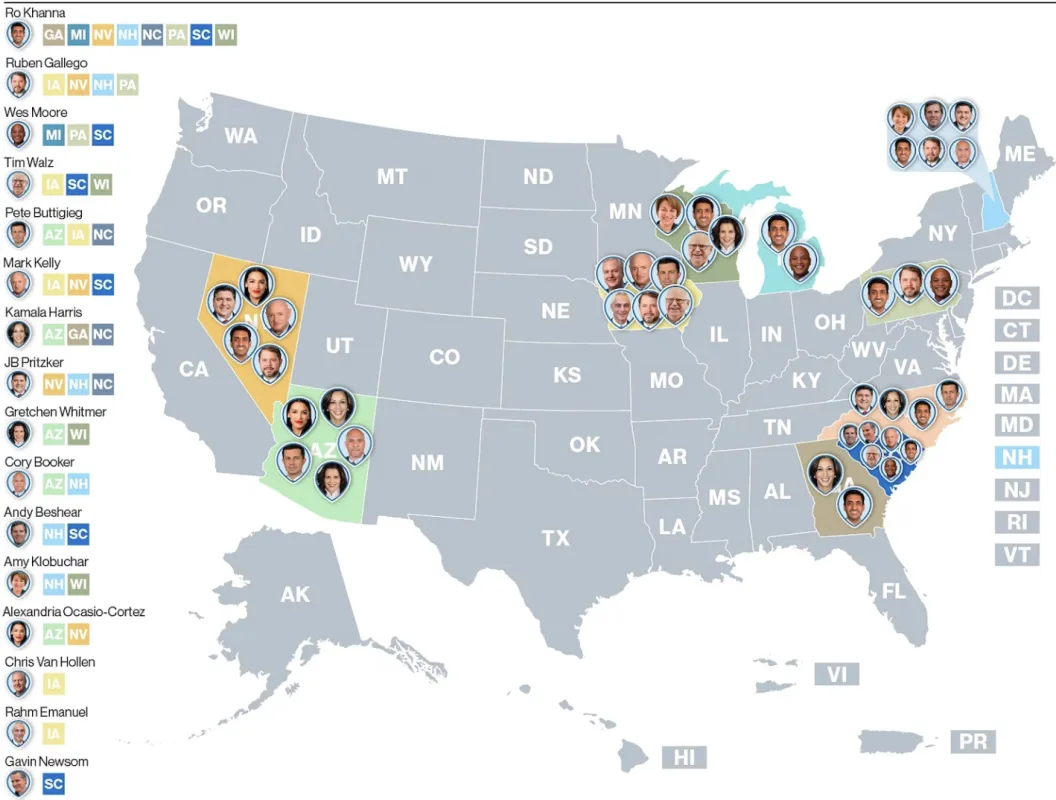
The United States Electoral College allocates 538 electoral votes across 50 states and the District of Columbia. A presidential candidate needs 270 to win. In practice, the vast majority of those 538 votes are predetermined — reliably Democratic states on the coasts and in the Northeast, reliably Republican states across the South and Great Plains.
What remains genuinely contested is a small cluster of states where the outcome is uncertain. In 2028, those states look very similar to the 2020 and 2024 battlegrounds — though the underlying political dynamics are shifting in ways that could redraw the map.
The 2028 Electoral College Baseline
Before examining the swing states, it helps to understand the structural baseline. Based on current Emerson College modeling and historical voting patterns, the 2028 electoral map starts with approximately:
- Safe or likely Democratic: California (54 EVs), New York (28), Illinois (19), Washington (12), Massachusetts (11), Maryland (10), Colorado (10), Virginia (13), New Jersey (14), and others — totaling approximately 236 electoral votes.
- Safe or likely Republican: Texas (40), Florida (30), Ohio (17), Indiana (11), Tennessee (11), Missouri (10), and others — totaling approximately 219 electoral votes.
- Toss-up or lean states: The remaining roughly 83 electoral votes distributed across competitive states that neither party can take for granted.
Under this baseline, neither party begins the 2028 race with a guaranteed path to 270. The election will be decided in the swing states.
Pennsylvania — 19 Electoral Votes
Pennsylvania has been the ultimate tipping-point state in recent presidential elections. It provided the decisive margin in 2020 and was among the last states called in 2024. Its combination of post-industrial working-class voters in Philadelphia's western suburbs, a large and politically diverse urban core, and a conservative rural interior makes it genuinely competitive every four years.
The presence of Josh Shapiro — a popular sitting governor — in the potential 2028 Democratic field adds an additional layer of intrigue. A Democratic nominee who can carry Pennsylvania's governor into the campaign as either a surrogate or a running mate would hold a significant structural advantage in the state's 19 electoral votes.
For Republicans, the 2028 challenge in Pennsylvania is identical to 2020 and 2024: winning back the suburban Philadelphia voters who swung toward Democrats in both cycles while maintaining dominant margins in rural counties.
Georgia — 16 Electoral Votes
Georgia's transformation from reliably Republican to genuine battleground was one of the most significant political developments of the 2020s. Democrats won the state's presidential vote in 2020 and captured both Senate seats in 2021. Republicans recaptured the Senate seats in 2022 and performed strongly in 2024, but the state's rapid demographic change — particularly suburban Atlanta's growth — means the underlying trend favors increasing Democratic competitiveness.
For 2028 Democratic candidates, Georgia's 16 electoral votes represent an expansion of the traditional "blue wall." For Republicans, it represents a must-hold state that requires genuine investment rather than the assumption of automatic victory that characterized Georgia politics before 2018.
Michigan — 15 Electoral Votes
Michigan was the heart of the "blue wall" that Democrats rebuilt in 2020, and it has remained a competitive state ever since. Its economy — heavily dependent on automotive manufacturing — makes it acutely sensitive to trade policy and cost-of-living pressures. With voters in April 2026 polls citing the economy as their top concern by a 40% margin, Michigan's working-class communities are likely to be a central focus of both parties' 2028 strategies.
Governor Gretchen Whitmer's continued presence as a potential 2028 candidate underscores the state's strategic importance. Michigan Democratic strategists argue that a nominee who can speak credibly to autoworkers and manufacturing communities would have a natural advantage not just in Michigan but across the industrial Midwest.
Wisconsin — 10 Electoral Votes
Wisconsin has been decided by margins of less than 1% in multiple recent presidential elections, making it one of the most reliably competitive states in the country. Its political geography — progressive urban centers in Madison and Milwaukee surrounded by conservative rural counties, with a competitive suburban corridor between them — mirrors the national divide in miniature.
For 2028, Wisconsin's 10 electoral votes are likely to be contested until election night. Both parties have invested heavily in the state's voter registration and turnout infrastructure after years of close results.
Arizona — 11 Electoral Votes
Arizona's emergence as a swing state reflects the same Sunbelt demographic shift driving Georgia's competitiveness. Rapid population growth in the Phoenix metro area, driven partly by migration from California and other states, has introduced a large bloc of college-educated suburban voters who have trended Democratic. The state's large Latino population — concentrated in the Phoenix area and along the border — represents an additional target for both parties.
Immigration policy will loom particularly large in Arizona, where border security has been a defining political issue for decades. 2028 candidates who can credibly address both the humanitarian and enforcement dimensions of immigration policy without alienating key voter blocs will have an advantage.
Nevada — 6 Electoral Votes
Nevada's 6 electoral votes may seem small, but in a close election every electoral vote matters. The state's unique economy — heavily dependent on tourism, hospitality, and gaming — makes it sensitive to consumer spending trends and labor market conditions. Its large Latino population (approximately 29% of the electorate) and significant union presence through the culinary workers' union have made it a Democratic-leaning but genuinely competitive state.
North Carolina — 16 Electoral Votes
North Carolina has come tantalizingly close to flipping Democratic in recent cycles before ultimately going Republican. Its growing Research Triangle tech economy and Charlotte financial sector have introduced suburban voters who push the state toward competitiveness, while its significant African American population in the eastern part of the state forms a key Democratic base.
For 2028, North Carolina's 16 electoral votes represent one of the clearest opportunities for Democrats to expand the map — if the right candidate can close the gap. Brookings Institution analysis from April 2026 specifically cited North Carolina as one of the states where Democrats have "a serious chance of flipping Republican-held" positions in 2026, a midterm result that could presage 2028 competitiveness.
What 270 Looks Like for Each Party
For a Democratic candidate to win the presidency in 2028 on the baseline outlined above, they need approximately 34 additional electoral votes from the swing state pool. The most efficient path: Pennsylvania (19) + Michigan (15) = 34. Any single additional state — Wisconsin, Arizona, Nevada, Georgia, or North Carolina — would provide a buffer.
For a Republican candidate starting from approximately 219 base electoral votes, the math requires approximately 51 swing state electoral votes. The most direct path: Florida (if it's genuinely competitive at 30) + Pennsylvania (19) + one additional state. Alternatively: Texas (40) + Pennsylvania (19) + smaller additions — but this assumes Texas remains firmly in the Republican column, which current demographic trends suggest deserves watching by 2028.
The Map Is Not Fixed
Electoral maps are not static, and the 2028 version could look meaningfully different from 2024's. States like Texas (40 EVs) and Florida (30 EVs) — both currently classified as Republican-leaning — have shown demographic trends that could make them more competitive. Minnesota (10 EVs), which Democrats have carried in every presidential election since 1976, received significant Republican investment in 2024 and could be contested again.
The safest prediction for 2028: the seven states above will again be the center of gravity for both campaigns, billions of dollars in advertising, and the country's political attention on election night, November 7, 2028.
Explore our interactive 2028 Electoral College Map to see the current state-by-state breakdown, and follow our Polls tracker for the latest state-level polling.