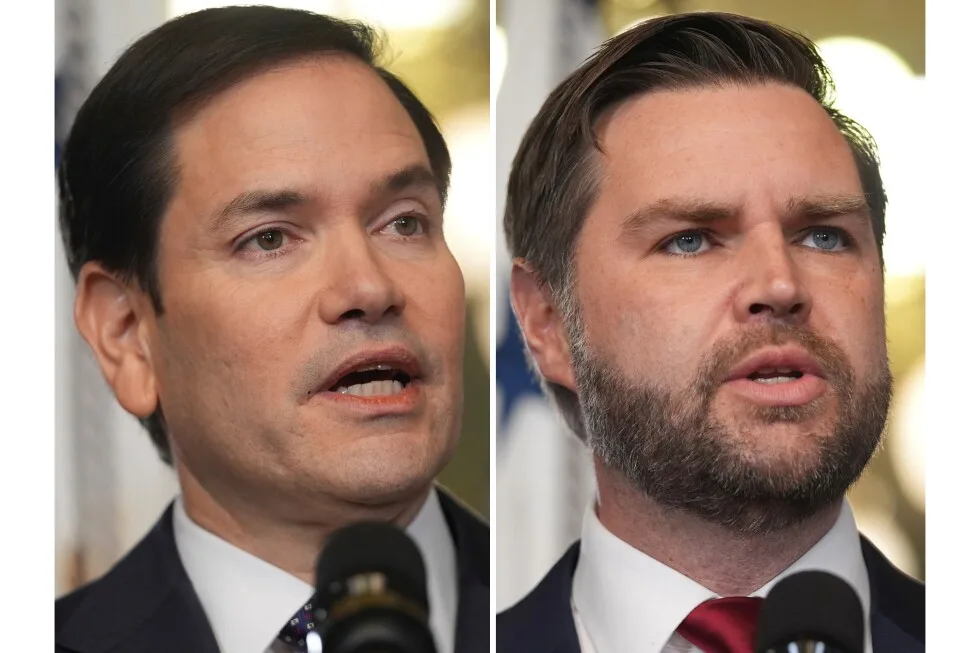
For much of the early 2028 Republican presidential race, Vice President JD Vance looked like a runaway frontrunner. But the latest polling suggests that race is tightening fast — and Marco Rubio is closing the gap at a remarkable pace.
A new Emerson College Polling survey of likely Republican primary voters shows Vance with 36% support, compared to Rubio's 35% — a statistical dead heat that represents a dramatic reversal from just months earlier. As recently as February 2026, Vance led the same poll with 52% to Rubio's 20%.
What the Numbers Say
The June 2026 Emerson poll of likely Republican primary voters puts the race in a new light. Vance leads narrowly at 36%, Rubio sits at 35%, Florida Governor Ron DeSantis and former UN Ambassador Nikki Haley each hold 5%, and 15% of respondents remain undecided.
That undecided bloc is significant. With nearly one in six Republican primary voters still uncommitted, the race remains fluid — and both Vance and Rubio are actively working to consolidate support before the first nominating contests in early 2028.
Political analysts note that Rubio's surge tracks with a broader pattern: as Trump's second term has progressed, Republican voters have begun seriously evaluating alternative leadership. Rubio has positioned himself as a reliable MAGA successor with strong foreign policy credentials, having served as Trump's Secretary of State since January 2025.
The Trump Factor
Perhaps no variable shapes the 2028 Republican primary more than President Trump's eventual endorsement. Trump, who is constitutionally barred from seeking a third term under the 22nd Amendment, has so far avoided anointing a successor — but has publicly praised both Vance and Rubio.
"You look at Marco, you look at JD Vance, who's fantastic," Trump said in a May 2026 interview on NBC's Meet the Press. "You look at — I could name 10, 15, 20 people right now just sitting here. No, I think we have a tremendous party."
Political strategists say Trump's eventual endorsement could be the most consequential single event of the 2028 primary season. "Whoever Trump will endorse as his successor — that's gonna be not just the leader in the clubhouse, I would be surprised if anybody else were to run and challenge whoever that may be," political analyst Matt Bado told ABC27.
Who Is JD Vance?
JD Vance, 41, has served as Vice President since January 2025 after winning the vice presidential nomination at the 2024 Republican National Convention. Before entering national politics, he served as a U.S. Senator from Ohio and authored the bestselling memoir Hillbilly Elegy, which documented his upbringing in Appalachian Ohio.
Vance emerged as the clear Republican frontrunner through 2025, at one point commanding 46% support in Emerson polling — more than the next four candidates combined. His backing is particularly strong among male Republican voters and those over 60, demographic groups that form the backbone of Republican primary turnout.
His trajectory, however, has not been without turbulence. A YouGov survey conducted in early 2026 found his support among Republican-leaning voters had softened from 41% in January to lower levels by April, a decline Newsweek attributed in part to broader unease within the Republican coalition over the administration's economic performance.
Who Is Marco Rubio?
Marco Rubio, 54, has served as Secretary of State under Trump since January 2025 after a lengthy Senate career representing Florida. He first ran for president in 2016, finishing third in a crowded field behind Trump and Ted Cruz before suspending his campaign after losing his home state primary.
As Secretary of State, Rubio has built a reputation as one of the administration's most polished communicators on foreign policy — a profile that plays well in Republican circles that prioritize global leadership credentials. His jump from 20% to 35% in the Emerson primary poll in a matter of months reflects both a growing comfort with his leadership style and declining enthusiasm for Vance among some segments of the Republican electorate.
The Rest of the Field
Beyond Vance and Rubio, the 2028 Republican field remains thin at the top. Ron DeSantis, the Florida governor who mounted an unsuccessful 2024 primary challenge against Trump, holds 5% — a figure that suggests his political rehabilitation after that bruising loss is a work in progress. Nikki Haley, the former South Carolina governor and UN Ambassador, also sits at 5%.
Donald Trump Jr. has registered in some early polls, including 13% in a May 2026 Newsweek-cited survey, but has not made public moves toward a campaign. Health and Human Services Secretary Robert F. Kennedy Jr. — an independent who joined the Trump administration — has shown up in some polling, though he is widely expected to be ineligible to appear on major party ballots.
What This Means for 2028
The tightening race carries several important implications. First, it signals that Vance's status as heir apparent is not guaranteed, and that a real primary contest — potentially including a formal Trump endorsement — is likely. Second, it underscores how dramatically the political landscape can shift in short periods; Rubio's 15-point gain in a single month of polling is extraordinary.
Third, and perhaps most consequentially for both candidates, it means the 2026 midterm elections may serve as a de facto first test. Both Vance and Rubio are expected to campaign heavily for Republican candidates in competitive House and Senate races — with each appearance functioning as a presidential audition for donors, party officials, and grassroots activists alike.
The 2028 election is scheduled for November 7, 2028, with the winner taking office on January 20, 2029. With over two years until election day, the race is still in its earliest stages — but polling like this makes clear that the invisible primary is already well underway.
For the latest polls and 2028 candidate profiles, see our Candidates page and Polls tracker.