Prediction markets don't have opinions. They have money. And right now, more than $430 million has been traded on Polymarket's 2028 presidential election winner market, with an additional $36.8 million traded on Kalshi's 2028 US Presidential Election winner contract. The total volume across all 2028 election-related markets on these platforms has crossed $700 million — an extraordinary level of speculative interest more than two years before the first vote is cast.
Here is what the markets are saying as of September 26, 2026 — and what it means.
Overall 2028 Election Winner: Current Odds
Polymarket and Kalshi show a tight race between the two leading Republicans at the top of the overall winner market, with Democrats collectively holding competitive odds.
| Candidate |
Party |
Polymarket |
Kalshi |
Trend |
| JD Vance |
Republican |
~20% |
~18-19% |
↓ Declining |
| Marco Rubio |
Republican |
~12% |
~15-16% |
↑ Rising |
| Gavin Newsom |
Democrat |
~18% |
~19% |
→ Stable |
| Alexandria Ocasio-Cortez |
Democrat |
~9% |
~11% |
↑ Rising |
| Jon Ossoff |
Democrat |
~8% |
~10% |
↑ Surging |
| Pete Buttigieg |
Democrat |
~6% |
~8% |
→ Stable |
| Josh Shapiro |
Democrat |
~5% |
~6% |
↑ Rising |
Note: Prediction market odds fluctuate constantly with news and trader activity. These figures represent approximate ranges as of late September 2026.
What Is Polymarket and Why Does It Matter?
Polymarket is a decentralized prediction market platform that allows users to buy and sell shares representing the probability of real-world outcomes. On Polymarket, a share in "JD Vance wins the 2028 election" currently trading at 20¢ means the market collectively believes Vance has approximately a 20% chance of winning. If Vance wins, that share pays out $1. If he loses, it pays out nothing.
Prediction markets became famous during the 2024 election cycle when they dramatically outperformed polling in predicting Donald Trump's victory — including calling the race for Trump hours before major networks called it. An anonymous French trader reportedly made over $80 million correctly betting on Trump's victory through Polymarket, an outcome that generated enormous media attention and massively increased awareness of prediction markets as a forecasting tool.
The $430 million in trading volume on Polymarket's 2028 winner market represents real money and real conviction — not opinions, not polling samples, but people putting dollars behind their beliefs about who will win.
What Is Kalshi?
Kalshi is a US-regulated prediction market platform that won a landmark legal battle to offer political event contracts to American users. Unlike Polymarket, which operates internationally, Kalshi is available to US residents and is regulated by the Commodity Futures Trading Commission (CFTC). It has become the preferred platform for US-based traders who want to participate in election prediction markets with regulatory backing.
As of September 2026, Kalshi has seen over $36.8 million in volume on its 2028 presidential election winner market and over $115 million across all 2028 Republican and Democratic nomination contracts. The platform is tracking more than 25 separate 2028 election-related markets.
Republican Nomination Odds
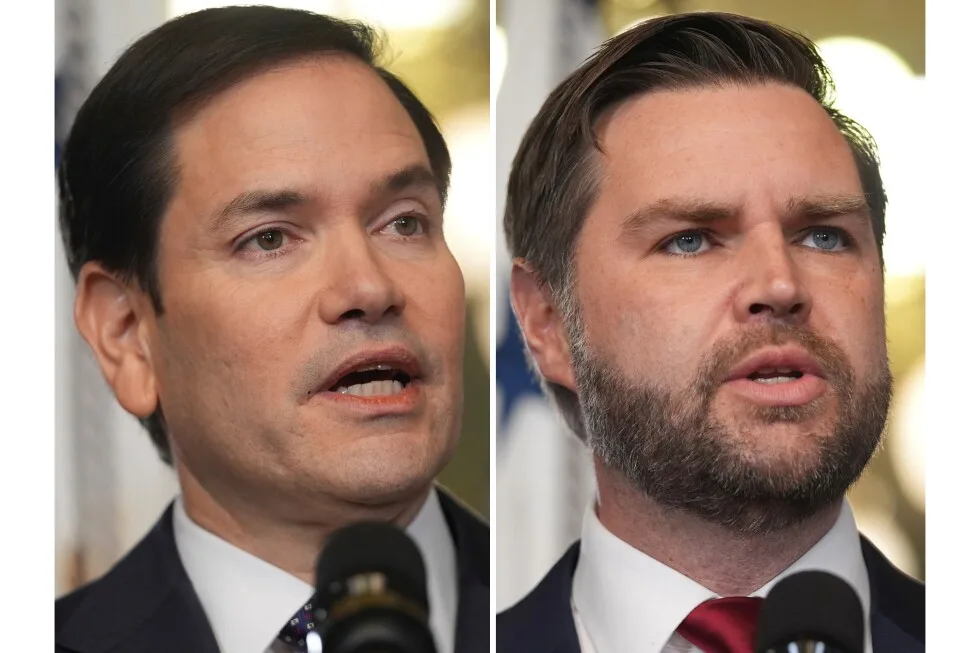
The Republican primary market is effectively a two-person race between JD Vance and Marco Rubio, with a dramatic tightening since early 2026.
In August 2025, Vance held a commanding lead on Kalshi at approximately 54% to win the GOP nomination. By May 2026, that lead had narrowed to roughly 35% — with Rubio surging to match him at approximately 30–35% on some platforms. The narrowing reflects Rubio's rising national profile from his management of the Iran diplomatic crisis as Secretary of State, and what many Republican analysts see as Vance's difficulty in maintaining frontrunner status while operating from inside the White House under the shadow of a sitting president.
The Kalshi Republican nomination contract shows:
- JD Vance: ~32% to win the Republican nomination
- Marco Rubio: ~30% to win the Republican nomination
- Ron DeSantis: ~5–8%
- All others: Below 5% each
Democratic Nomination Odds
The Democratic nomination market is far more competitive, with no candidate holding a commanding position. As of early September 2026, Kalshi data shows:
- Gavin Newsom: ~22% to win the Democratic nomination
- Alexandria Ocasio-Cortez: ~17% to win the Democratic nomination
- Jon Ossoff: ~17% to win the Democratic nomination
- Kamala Harris: ~10–12%
- Pete Buttigieg: ~8–10%
- Josh Shapiro: ~6–8%
- Andy Beshear: ~5–7%
The most striking data point in the Democratic market is the surge of Georgia Senator Jon Ossoff, who hasn't even won his own 2026 Senate reelection yet but appears in head-to-head matchup markets alongside AOC and Newsom. Polymarket's "2028 Presidential race: exact outcome" market shows "Jon Ossoff defeats Marco Rubio" and "AOC defeats JD Vance" as leading scenarios in the exact matchup contracts.
The Rubio Surge: What Markets Are Pricing In
The most significant market movement in the 2028 prediction markets since June 2026 has been the rise of Marco Rubio. His Polymarket odds have risen from single digits in early 2026 to approximately 12–18% across platforms — the largest gain of any candidate in the cycle.
Markets are pricing in several factors behind Rubio's rise: his visible role managing US diplomacy during the Iran strikes and Strait of Hormuz closure has given him a foreign policy credibility that is rare in the current Republican field; his Spanish fluency and Cuban-American background give him potential appeal with Latino voters that Vance does not have; and his positioning as a more traditionally conservative figure than Vance may allow him to expand the Republican coalition in critical suburban areas.
Party-Level Odds: Who Will Win the White House?
At the party level, Kalshi's "2028 Presidential Election winner? (Party)" market shows Republicans currently favored, though the margin is narrower than the 2024 cycle would suggest. The specific split varies by platform and has been volatile in response to news events — the Iran conflict initially moved markets toward Republicans before broader economic uncertainty about oil prices and inflation began narrowing the gap.
Should You Trust Prediction Market Odds?
Prediction markets are not infallible — they are a market, and markets can be wrong. But they have historically outperformed polling at equivalent time horizons because they aggregate the beliefs of people who have actual financial stakes in being right.
Two years before an election, however, even prediction markets should be treated with significant humility. The 2028 field has not formally declared. No debates have been held. No voters have cast a ballot. Events between now and November 2028 — economic conditions, international crises, health events, major scandals, or a breakthrough candidate nobody has yet identified — will almost certainly reshape these probabilities dramatically.
What the current markets tell us is not who will win in 2028. They tell us how the most informed and financially committed political observers are currently thinking about the race — which is itself valuable information.
Track live 2028 polls on TalkBea's Poll Tracker and see where every candidate stands on our Candidates page. Take our 2028 Candidate Match Quiz to find out which presidential contender aligns with your views.